Unless you drown the queen in the process.
convinces them it’s raining so they stop home
Until the next day.
Once swarming starts they WILL go soonest, Even doing an artificial swarm I would put an excluder under the AS for a few days.
Unless you drown the queen in the process.
convinces them it’s raining so they stop home
Until the next day.
Once swarming starts they WILL go soonest, Even doing an artificial swarm I would put an excluder under the AS for a few days.
We were literally sitting by the hive as the bees started pouring out with that incredibly loud sound so got straight on the hose. We checked each frame carefully yesterday (taking on board what you said Dee) and can’t see a single queen cell and our queen is still there. So unless we were mistaken about their behaviour (we have had a hive swarm before while home to see it) for now they seem ok to stay. If they swarm now such is life.
What is AS?
Hi Siobhan, this is what I have found. If you aren’t seeing any queen cells it is very unlikely your hive is swarming. Sometimes when new bees are engaging in their first orientation flight at the same time, it will certainly appear as if they are swarming. Opening up the brood to give the bees more work to do in the brood box is a great idea.
Thanks Jeff, that’s reassuring, alongside the sheer numbers, it was the sound mostly that made us think they were swarming. I also wonder if the hive was too hot, although they were not bearding, which I would expect. We are going to move it to a shadier location. In principle I don’t mind a swarm, but she’s such a good queen, we barely need to smoke the hive to work them.
Your welcome, it’s best to try to avoid swarming if possible. The new queen they make might not be as quiet as the one you have now. What I do is preemptive swarm control measures. I try to weaken & open up the brood before they start preparing to swarm. That way I make new colonies & let them make new queens by natural selection. I sell the surplus colonies. Yesterday I sold one to a Flow beekeeper.
@siobhanfaire AS Artificial Swarm - basically what I think Dee is saying that if you put the QX - Queen excluder - under the queen when doing an AS she cannot leave to swarm again - some hives will Swarm and then Cast ( a secondary or smaller swarms after the initial swarm).
Problem is each time they swarm they take 1/2 - 2/3 the original nest with them and any consequent casts lowers the hive numbers considerably and can leave the hive undersized and a danger to their survival either due to too few numbers or susceptible to pests and diseases. This can often happen with a Virgin Queen
Casts and secondary casts can occur but these are better reunited with the hive if you catch them. You will need to learn about the newspaper unite.
Cushman does a nice article
http://www.dave-cushman.net/bee/unitenewspaper.html
This is where a snelgrove board is useful:
http://www.bbka.org.uk/local/barkston-ash/started/artificial-swarm~print.shtml
Sommerset beekeepers
http://www.somersetbeekeepers.org.uk/colony_unite.pdf
I have found that in the vast majority of cases you can stop bees from ever swarming by continuing to exercise preemptive swarm control measures. The good part is: The hive continues to produce a good amount of honey, your not checking for queen cells on a weekly basis & you buildup your colony numbers to either accumulate or sell.
Pre-emptive swarm control (except perhaps by a manoeuvre called a Demaree) by opening up the brood box or checker boarding is difficult in our climate as we don’t tend to have significant predictable spells of good weather. You put in extra frames, it gets cool and rains for two weeks and the bees are badly set back. That’s why you find more reactive swarm control practiced in the UK.
We expect most of our colonies to swarm every year and have spare kit to manage this.
@siobhanfaire…You may well have witnessed a mass orientation flight. These usually occur in the early afternoon when you see lots of new bees getting a lie of the land. If you watch them they will dart about in front of the entrance then circle the hive in ever increasing circles before going in. Foragers, on the other hand just fly straight out usually not even stopping on the landing board.
The reason I mentioned the queen excluder under the brood box (or a strip across the entrance) is that sometimes the swarm will go even if you have performed an AS. This is usually because you have left it to the point they would have been swarming if you had not interfered. If after swarming (or AS) you do not reduce the queen cells you will, as Valli pointed out) have afterswarms. The bees guard the about to emerge virgin queens to prevent their escape from their queen cells. If the colony is a strong one and they have made lots of queen cells they will let one out and when she is ready to fly in a few days they will swarm again with half the bees. This will be repeated till either the colony is severely depleted or more often until it is a size that can survive when the bees will reduce the queens to the one they choose. It’s not often that queens are led to fight it out.
If you inspect a colony at this time the bees lose control of the queens and you can see lots of new queens emerging at once.
Hi Dee, I should clarify, I only do a preemptive swarm control on the hives that are nearly bursting at the seams with bees & stores. In all those cases 2 weeks of bad weather wouldn’t be a problem for the bees. As a general rule, (bees don’t always follow the rules) it’s only hives that are bursting at the seams with population that prepare to swarm. Lots of times I catch them right at the point where the first queen eggs are laid. In those cases I can suppress the hives urge to swarm by checker boarding.
The recess (large bee space) in my lids are a guide for me. If I find a huge mass of bees up there doing nothing, for me, that’s a good sign the bees are going to swarm & I need to take immediate action. If I find lots of bees up there building comb, I take action, but not as a matter of urgency.
Yes, lots of bees doing nothing is a good sign, even before you look in the hive. Here we spot them hanging about at the bottoms of the frames, a bit like when they are wax building but not in “ropes”.
The idea is that as the hive becomes more congested the foraging bees are not met to have their loads taken and loiter about with little purpose. I did once catch a colony just before they left and I could hear the scout bees piping the swarm out. Wonderful stuff.
Hi there Dragonfly,
I’m in Conjola, NSW, and have just got my first Flow Hive. I ordered 2, one is the founding member Cedar, the other a standard pine. Very excited!!
I’ll be putting the first one together today.Martin (Pom)
Hey there Pom!
Welcome to the madness! Great news to read about your new arrival. Keep us all posted on your progress ok?
Hey there Red - did the red high heels, lipstick and a suitable ‘come hither’ look work for you? Did you catch a swarm?
Thanks Dragonfly.
I surely will.
I found that James Squires Orchard Crush is a wonderful help in all that I do…Hee Hee…
Hi there. Knocking on the door to enter the South East NSW/ACT group.
I live in Canberra, but hive is located on our bush block near Araluen/Braidwood.
Good rain recently, but our area is almost all natives, and very little flowering at the moment. Installing nuc tomorrow, and will feed.
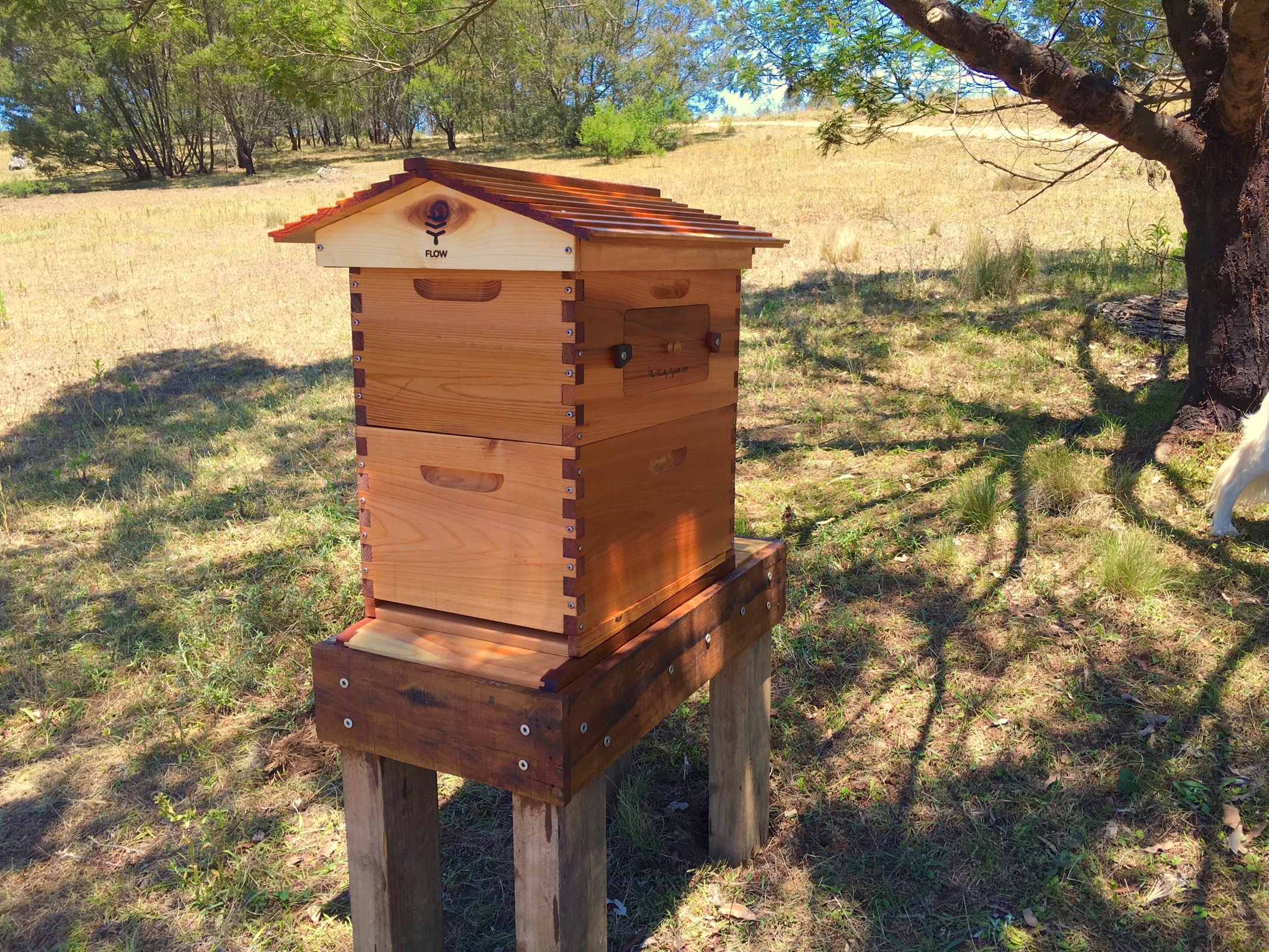
Looks good Rob. Is there water nearby?
Lovely stand! Did you manufacture it yourself? 
We have a permanent creek about 300m away, and after rain we have a few gullies with waterholes. I will put out a 10L watering system during dry spells.
My son (age 15) made that out of old pallets and scrap.
Hi all, thought i’d revive this thread a little.
I have been beekeeping in Canberra for a few years and prior to that in QLD too. Currently run 8 Langstroth hives in Canberra (and still a couple in QLD). Looking to pick up a Flow Hive to augment existing training offerings, but keen on feedback first.
How are your flow hives going in Canberra? and has anyone has managed to pull honey off this season? (if so, how much?)
Cheers!