I have just purchased a table saw and plan to build a Warre hive, I have 7 Queensland red cedar boards 300mm x 22m x 1300mm. Has anybody dealt with this timber, is it as durable as Western Red Cedar?
I realise its hard to come by now, but I think it would look a treat if I could finish it with tung oil.
this should give you all the info.
https://www.business.qld.gov.au/industries/farms-fishing-forestry/forests-wood/properties-timbers/red-cedar.
Very ideal for purpose… above ground durability (with no sealing or treatment) 15-40 years and is relatively light and easy to work with.
Go go go.
We use some Queensland Red Cedar at the Men’s Shed and it is light and easy to work with, but it is hard to come by and very expensive. It used to be used for furniture making of very solid pieces and that is most of what we get donated to the shed. It is very straight and close grained and certainly looks good. It bruises easily.
When you have made the hive give a pic with an update please. When Qld Red Cedar was growing everywhere it was so cheap it was sold in most of Australia without it really being appreciated.
Cheers
If everything goes well this year and I really get into beekeeping, I’ll build a top bar next year when I do a split (hopefully)
I have almost completed my build
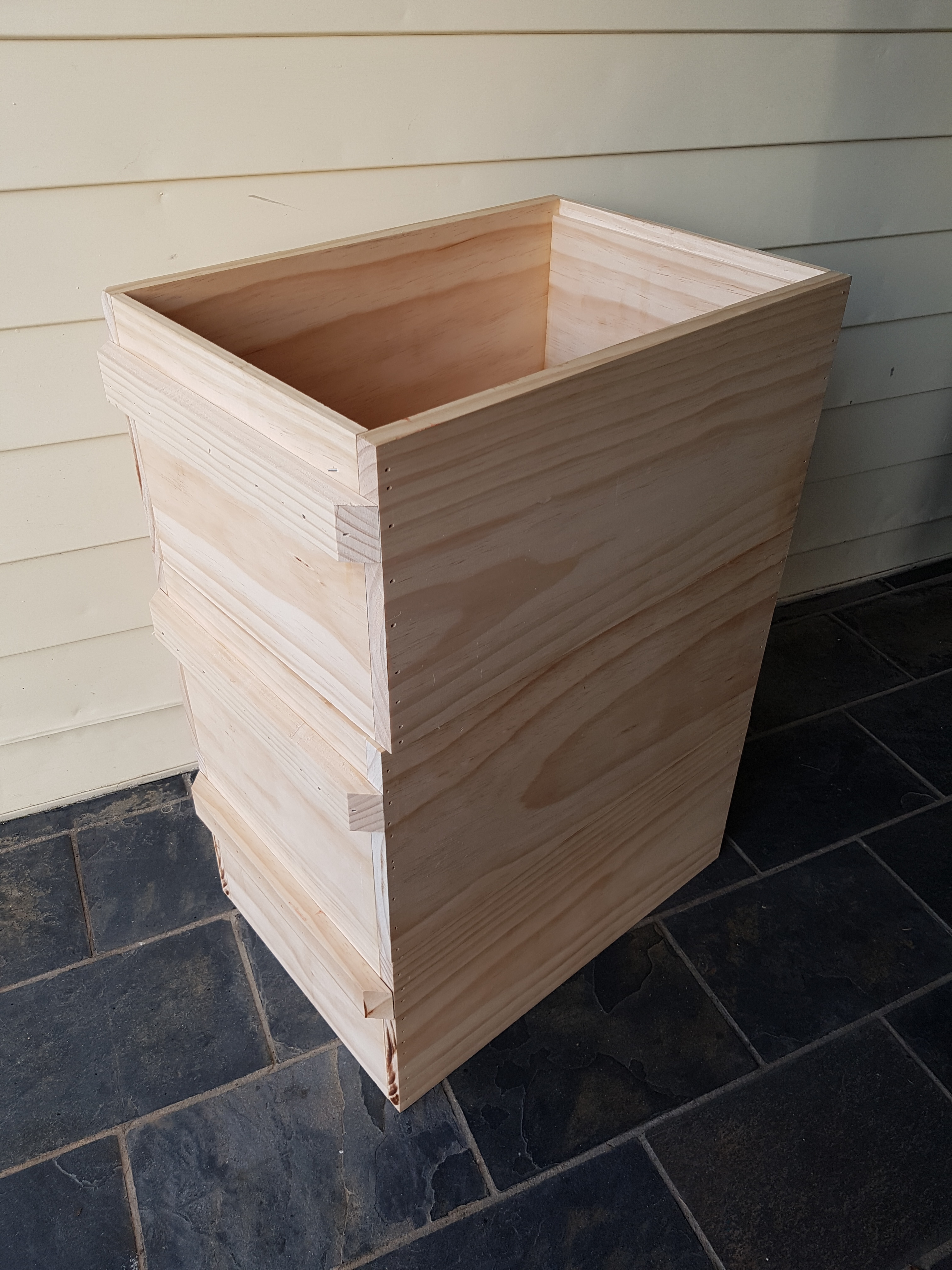
Just need to fill the nail holes and give a few coats 
As for the frames, I’d like to try the “starting strip” method, but the frames I’m buying from iwoohoo here in Sydney don’t have a strip in the top that you can take off…
The gap in the frame is 3mm so I scouted bunnings today and couldn’t really find much that I could easily use.
There was this which is called a Balsa Wood
I know that there actually is a Balsa Tree but I can’t verify if this product has any glues in it…?
Does anyone have any other ideas as to what to use in the frames as starter strips?
2 Likes
Looking good.
For starter strips I use 3mm ply wood cut into strips and glue it in. Others use tongue depressors or paint stirrers.
If you have kids then get them eating ‘paddle pops’ as they make excellent starter strips, or you can buy Balsa wood at a hobby shop where they sell model aircraft and the like. Both can be glues in using PVA Aquadhere glue and it will not worry the bees.
Cheers
I tried the paint stirrers from bunnies but they’re both thicker than 3mm and wouldn’t go in.
Is this the 3mm Ply? Don’t know how I missed that.
Tongue depressors or paddle pop sticks is another good idea though you have to stick a few in there.
@Peter48 Are you familiar with The Balsa Wood that bunnings sell? There shouldn’t be anything harmful in there right? Just pure wood?
I really like the Balsa sheets I saw today, you can snap and glue in no time
Some ply wood glue has formaldehyde in it Adam, or at least it use to, so I would check any ply is free of it before using it.
Cheers
Balsa wood is untreated in every way, you can cut it with a Stanley knife either with the grain or across it. Again glue it in with Aquadhere.
Cheers
Yes Peter, goes with out saying. Is the balsa going to be strong enough to support a full comb?
Your other option with a table saw is make your own
@Peter48 Thanks mate, then it’s settled. Balsa it is
It’s not too soft for the purpose with all that weight is it?
Which leads me to another question, is the starter strip enough on its own or should I wire the frames?
For the record, I called Selleys today and confirmed their Aquadhere PVA does not have any formaldehyde and is specifically “safe for beehives, because some (can’t remember the name) honey company in NZ have been using it for a long time”
This is smart!
Balsa would is quite strong, the only thing against it is that it bruises easily. But model aircraft used to be made using Balsa wood and I used to crash my plane regularly when I was young, it stood up to abuse really well. 
I have been using Aquadhere for at least 40 years in making my bee hives, a joint glued with Aquadhere won’t fail, the wood will split first.
Up front, I wire my frames and fit foundation made from bees wax. It works for me and my way of bee keeping. With a strong colony the frames are built out in a couple of days and are getting honey stored in them. I haven’t the time to waste repairing broken or wonky comb.
Cheers
1 Like
Thanks @busso, interesting the uses were boat building, my uncle was a timber boat builder and the boards came from his old workshop. They are heart wood as the colour is a deep red
1 Like
No worries @Peter48 I will take photos of boards on my next week off
1 Like
Hi Rani, I use the Bunnings balsa wood from Bunnings for starter strips and have had no issues. Once the bees built the comb the wax takes the weight as is connects to the top bars. As @Peter48 has mentioned use Aquadhere , I place drops of glue at each end of slot, one in the middle and then halve way between, five drops in total. It can deform the edge of strip if pressing in with finger so use a piece of timber along length of starter strip and tap in with small hammer.
2 Likes
Awesome mate, thanks for the detailed explanation.
What about wiring? Is it necessary with foundationless?
Also would like to know if it takes much longer for the bees to draw comb on foundationless vs foundation?
Oh, also. I know that you should put 1 foundationless between 2 drawn out frames (not empty foundation frames). Obviously I’m just starting out, what can I do?
I’ll explain it as to how it applies to my bee keeping thru 45+ years at it and many years of trying other ideas to make life easier for the bees and for me.
Wiring helps to hold the comb in place and as a matter of course I wire every frame I make because although it initially goes into use in the brood box it will eventually be used in a super for honey storage and extraction of the honey. It is in extraction in a centrifuge that unwired frames flex and the comb breaks. So as every frame will end up in the centrifuge I wire them before they are used. My bee keeping has to be time efficient and all of my gear has to be adaptable and interchangeable in what it can be used for. Often when you look at a frame of capped brood on a wired frame you will see a line across the frame under the wire that doesn’t get used for brood, but overall that is a small price to pay.
As for the time taken for bees to draw out comb with and without foundation ask a half dozen bee keepers and you will get at least ten different answers. But it is a fact that foundation is bees wax and it takes honey for bees to produce the wax and time in making it and working it for the purpose. So I see a saving in time and stores if I add a sheet of foundation to the frame. I have had comb built out and put to use if the bees need it in 48 hours or less. If it is not needed by the colony a frame can sit untouched till it is needed. Bees don’t forward plan making honey comb, when it is needed they make it.
I realize you are just starting out in bee keeping and this forum is great to get tips advice from those that have been at it for some time, especially those that have tried different ideas to find what works for them best. Remember the old saying “there is more than one way of doing it” and that applies to bee keeping.
Cheers
1 Like
Thank you for the great explanation.
You’re right, at the end of the day you start with whichever method you believe is best and then through trial you find the methods which suit you
And yes, I’ll be wiring all my frames 
1 Like
Hi Rani, I think you’re best off to use wire with properly fitted wax foundation. You need to embed the wire into the wax as much as possible because the bees view bare wire as a foreign object & will build around it & make, in a lot of cases a mess. Some people use fishing line, however the bees see that as a foreign object also.
With properly fitted wax wax foundation, the bees do a beautiful job of drawing out the comb. In most cases, they’ll draw out nearly 100% worker comb, which you wont get by using foundationless frames.
cheers
2 Likes
Thanks Jeff, I have decided to buy and embed foundation into the wire on all my frames.
Now onto the next build pieces, I need to build screened bottom board (with a drawer), an inner cover, and a telescoping top cover (with ventilation holes)
Now, I can’t seem to find any pine board less than 19mm thick at bunnings, but I did come across Masonite which apparently doesn’t have any chemical bond agents etc
Is it fine to use?